
- Create real change
- Transform your career
- Join our community
Unequal representation of patient groups and diseases in research is both a cause and a consequence of health inequality
Underrepresented populations are underserved by healthcare and underrepresented in research for many different reasons:
- Protected characteristics such as gender or ethnicity
- Social circumstances that marginalise people such as poverty or homelessness
- Health conditions such as mental health or rare diseases
If we don’t study disease in a particular group, how do we know that our discoveries are relevant to people in that group?
HARP will be based in the ethnically-diverse East End of London, which is home to 2.5 million people from almost 100 nations of origin and where average healthy life expectancy is 57y for women compared with 70y for the highest in London.
Our track-record of engagement and addressing health inequalities through research means that when new challenges emerge we can enrol representative numbers of ethnic minority participants, such as 30% in recent international Covid-19 vaccine research.
Multi-layered
training
A comprehensive, multi-layered doctoral training experience
This doctoral training programme (DTP) equips fellows with the skills, knowledge and leadership capabilities to conduct impactful research, particularly in underrepresented populations and diseases.
Through a combination of research-focused workshops, a bespoke career development programme, core methodological training and tailored project-specific support, the DTP provides structured learning alongside sustained mentorship and peer engagement throughout the three-year PhD.
Training in research relevant to underrepresented populations and diseases
This is delivered in 2-monthly rolling workshop sessions over three years (18 workshops altogether: Twelve workshops are delivered by experienced multiprofessional clinical researchers from QMUL/CSGUL who work with different underrepresented populations and diseases. These interactive workshops provide successful examples of engagement and discuss contentious issues.
Six workshops focus on Community and Patient engagement training. Sessions are co-chaired by fellows with patient group leaders, community groups such as Social Action for Health (see letter of support), PPI experts and City’s Centre for Mental Health Research.
All the workshops are followed by presentations from fellows, discussion and reflection.
Career development programme
We have partnered with Bayes Business School to develop an innovative and bespoke Career Development Programme for all Fellows in this DTP. City Business School has an international reputation for delivering high-quality executive level training in the Health Sector, and our fellows will have access to this unique opportunity through this Partnership. The Programme will be delivered in small groups (each intake) in five full-day sessions over the first year. Sessions will focus on ‘Personal Leadership’, ‘How Human Factors Impact Research Culture and Environment’, ‘Leading Innovation in Teams and Collaborations’, ‘Managing Personal and Professional Change’ and ‘Running a Successful Research Group’. Action learning groups will be formed during training, which then will continue over the 3-year PhD for ongoing peer-support.
HARP PhD Programme
Pre-Doctoral Training – Optional, Up to 12 months
PhD Phase – 3 years, Training workshops
Career Development Programme – Post-Doctoral Support After thesis submission, 20% FTE over 12 months, Mentoring for 24 months
General research training
Fellows will complete modules in statistical methods including research design, thematic and content analysis, systematic reviewing, patient and public involvement (PPI), Good Clinical Practice and ethics, information governance, health and safety, community working, presentation and writing skills, impact, dissemination and engagement methods including social media and podcasts and communicating with the public and policy makers. These will be selected from QM Academy and City Doctoral College course elements. General training relevant to underrepresented populations and diseases will be given by DTP Faculty: engagement and feedback, specialist funding sources and writing successful grant and fellowship applications.
Project-specific training
Together with supervisors, fellows will use Training Needs Analysis Tool of the Vitae Researcher Development Framework to produce a training plan, which can be adapted as required. Project-specific training might include elements of research design, specific technologies or analytical methods and will be delivered through internal QMUL/City courses or externally as directed by the supervisors.
Fellows will attend Centre/Institute seminar series and have opportunities to join seminars, cross-disciplinary symposia and attend congresses. Fellows will present at Centre/Institute meetings and to wider audiences including Graduate Studies Days, Integrated Academic Trainees’ Day, QMUL’s showcase William Harvey Day and the DTP Annual Symposium.
Download training workshop dates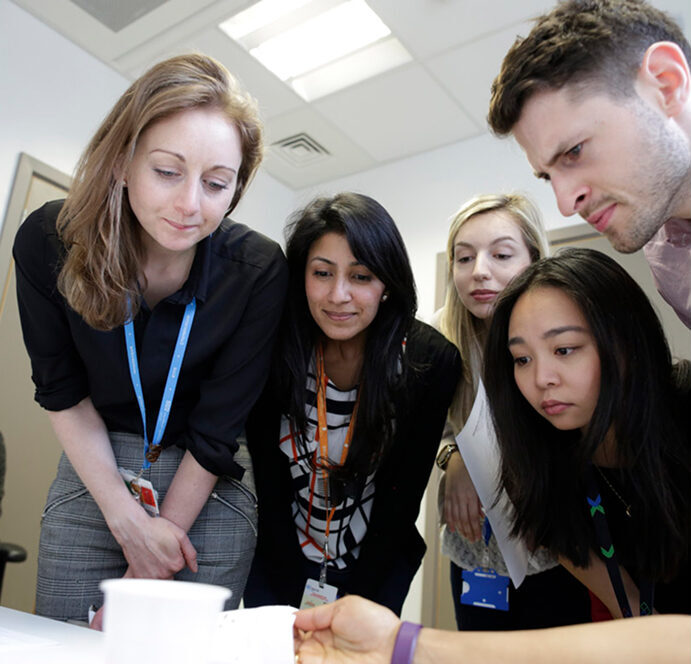
Our culture
We are building a high-quality clinical academic community drawn from diverse professional and personal backgrounds, embedded within a progressive and supportive research culture
Fellows are mentored to navigate career transitions and trained to deliver interdisciplinary biomedical and social research focused on underrepresented populations and diseases.
Together, this community will develop the insight and imagination to recognise, address and reduce health inequalities, championing a positive research culture throughout their future careers for the benefit of disadvantaged communities across the UK and beyond.

Apply now“I could honestly not have been more supported, enabled, and helped through this process by the HARP directors, the administrative team, and the entire research infrastructure at Queen Mary.”
Rachel Preston, paediatric speech and language therapist